The following poem is written so the entire journey is structured around Je Tsongkhapa’s presentation of the Three Principal Aspects of the Path (lam gyi gtso bo rnam gsum):
- Renunciation (Nges-‘byung) – turning away from cyclic existence.
- Bodhicitta (Byang-chub sems) – the altruistic mind seeking enlightenment for all beings.
- Correct View (Yang-dag lta-ba) – the wisdom realising emptiness through dependent origination.
Without renunciation, one remains attached to saṃsāra.
Without bodhicitta, one remains concerned primarily with oneself.
Without the correct view, one cannot cut the root of saṃsāra.
Thus the poem naturally unfolds through these three principal aspects.
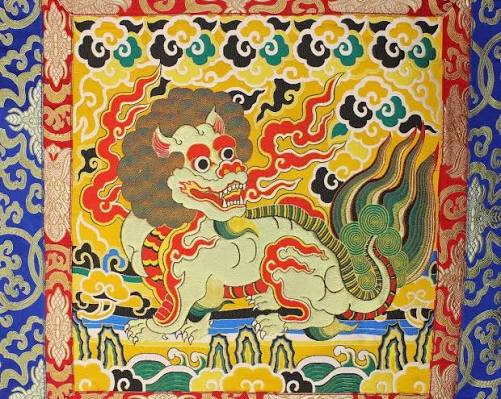
The Mirror of the Snow Lion
A Poem of the Three Principal Aspects of the Path
Long ago, beneath the sky, Where clouds like drifting prayers passed by, A traveller walked through night and day, Yet never found a lasting way.
He gathered pleasures by the score, Yet always wanted something more. He built his castles in the sand, Then watched them fade from his own hand.
The praise of others made him rise. Their blame brought storms across his skies. Gain and loss, delight and pain, Circled round and round again.
Sometimes he climbed to heaven’s height, Wrapped in comfort, drenched in light. Sometimes he sank through fear and flame, Yet every realm appeared the same.
The wheel kept turning without rest, And nowhere could his heart find nest.
One evening, weary to the bone, He wandered through the hills alone, Until he saw upon a ridge A Teacher standing near a bridge.
His gaze was clear as autumn streams. His smile dissolved a thousand dreams.
The traveller bowed.
“Please tell me true: What should a wandering being do? Why does happiness disappear? Why does suffering return these years?”
The Master pointed toward the plain.
“Look carefully at joy and pain. Do all conditioned things not pass? Like morning dew upon the grass?”
The traveller watched the fading sun, And saw decline in everyone.
The young grew old.
The strong grew frail.
Success itself at last would fail.
Then in his heart there softly stirred The meaning of the Teacher’s word.
The First Principal Aspect:
Renunciation
The Teacher spoke:
“Child of the Way, You’ve wandered thus from day to day, Not because pleasures are a sin, But because you seek refuge within The very things that cannot stay, And thus they always slip away.
The gods descend. The kings grow weak. The future turns from all you seek.
The six realms rise. The six realms cease. Yet none contain unchanging peace.
From ignorance come troubled states. From afflictions karma creates. And through that karma beings roam Still searching for a lasting home.”
The traveller looked across the land, Like grains of sand beyond all sand.
He saw how every being there Desired joy and freedom from despair.
Yet all were caught within the stream, Mistaking shadows for the dream.
At last he turned his heart away From clinging to another day Within the wheel that spins around, Where birth and death are tightly bound.
A deeper wish began to grow:
“I must become completely free Of all cyclic misery.”
The Teacher smiled.
Renunciation’s seed Had entered where it had its need.
The Second Principal Aspect:
Bodhicitta
But then the Teacher raised his hand.
“To seek your freedom is grand. Yet look again beyond yourself. Leave self-concern upon the shelf.”
The traveller gazed across the earth.
He saw each mother giving birth. Each father struggling to provide. Each creature running, trying to hide.
Birds above and beasts below, All desired happiness to grow.
The wealthy and the poor the same. The wise and foolish shared one aim.
Like him, they sought enduring peace. Like him, they wished their pain to cease.
Then suddenly his heart grew wide, As vast as oceans, deep as tide.
The boundaries between self and other Softened like snow in springtime weather.
“How can I leave these beings here, Still trapped by suffering, hope, and fear?
Until all beings cross the sea, How can liberation satisfy me?”
Compassion blazed brighter than flame, Yet free from ownership or claim.
And from that tenderness began The vast and noble Bodhisattva plan.
Not merely seeking freedom’s shore, But Buddhahood forevermore, For every being, far and near, Without exception, without fear.
The Teacher bowed his head in praise.
“The jewel of Bodhicitta now displays.”
The Third Principal Aspect:
Correct View
Then through the silence of the night, The Teacher spoke of wisdom’s light.
“Now listen well, for here must cease The root that blocks liberation’s peace.
You think there lives a solid ‘me’, Existing independently.
You think that things stand on their own, Established firmly as a stone.
Look carefully.”
The traveller did.
He searched the body where self seemed hid.
Within the aggregates he sought The owner whom he always thought Was sitting somewhere deep inside, The sovereign self of grasping pride.
Yet nowhere could that self be found, Though personhood still moved around.
Confused, he asked,
“What can this be? The self is there, yet I can’t see.”
The Teacher pointed at the moon Reflected in a mountain lagoon.
“It appears. Yet search the pond. Can you find that moon beyond Its dependence on the sky, The water and the viewer’s eye?”
“No.”
“And yet it still appears?”
“Yes, clear.”
“Then listen carefully, and hear.
Conventionally, persons exist. Karma exists. No fact is missed.
Cause and effect function perfectly. Dependent origination acts unfailingly.
Yet ultimately when analysis seeks An object established by its own feats, By its own nature, From its own side, Such a thing cannot abide.
This is the object to negate. Nothing less and nothing great.
Not appearances. Not cause and effect. Not morality. Not intellect.
What is empty is inherent existence. Not conventional existence.”
The traveller sat then through the dawn, As mist dissolved upon the lawn.
At last he saw the subtle divide Between appearance and what abides.
Things appeared inherently there.
But wisdom found no essence anywhere.
They functioned. Appeared. Arose dependently.
Yet lacked intrinsic identity.
Then like lightning through the sky, The meaning of dependent origination flashed nearby.
Because things arise dependently, They are empty ultimately.
Because they are empty ultimately, They function dependently.
Appearance safeguarded him from the abyss Of believing nothing exists.
Emptiness saved him from the chain Of believing things self-exist and remain.
The two united.
The extremes were gone.
The Middle Way began to dawn.
The Teacher rose.
The morning came.
Yet nothing outward looked the same.
The mountains stood.
The rivers flowed.
Travellers travelled every road.
But now each appearance, every sight, Became instruction in wisdom’s light.
Every sound proclaimed dependent arising.
Every encounter encouraged analysing.
Every loss weakened self-grasping’s thread.
Every gain revealed projections instead.
Thus all phenomena became the path.
Every pleasure.
Every wrath.
Every failure.
Every success.
Every challenge.
Every blessedness.
For the world had turned into a mirror, Making ignorance ever clearer.
And through that mirror wisdom grew, Revealing what the Buddhas knew:
Renunciation frees the heart From seeking refuge in saṃsāra’s art.
Bodhicitta makes compassion vast, Embracing future, present, past.
The View cuts ignorance at its root, Leaving self-grasping without fruit.
These three, united, become the way, The path the Victor taught that day.
And as dependent arisings appear, May wisdom grow year after year.
Until appearance and emptiness unite, Like moon and water bathed in light.
And every being, without exception, Awakens through correct perception.
Free from grasping.
Free from fear.
The nature of reality shining clear.